Exploring Rural Life and Humanity in Laxma Goud’s Paintings
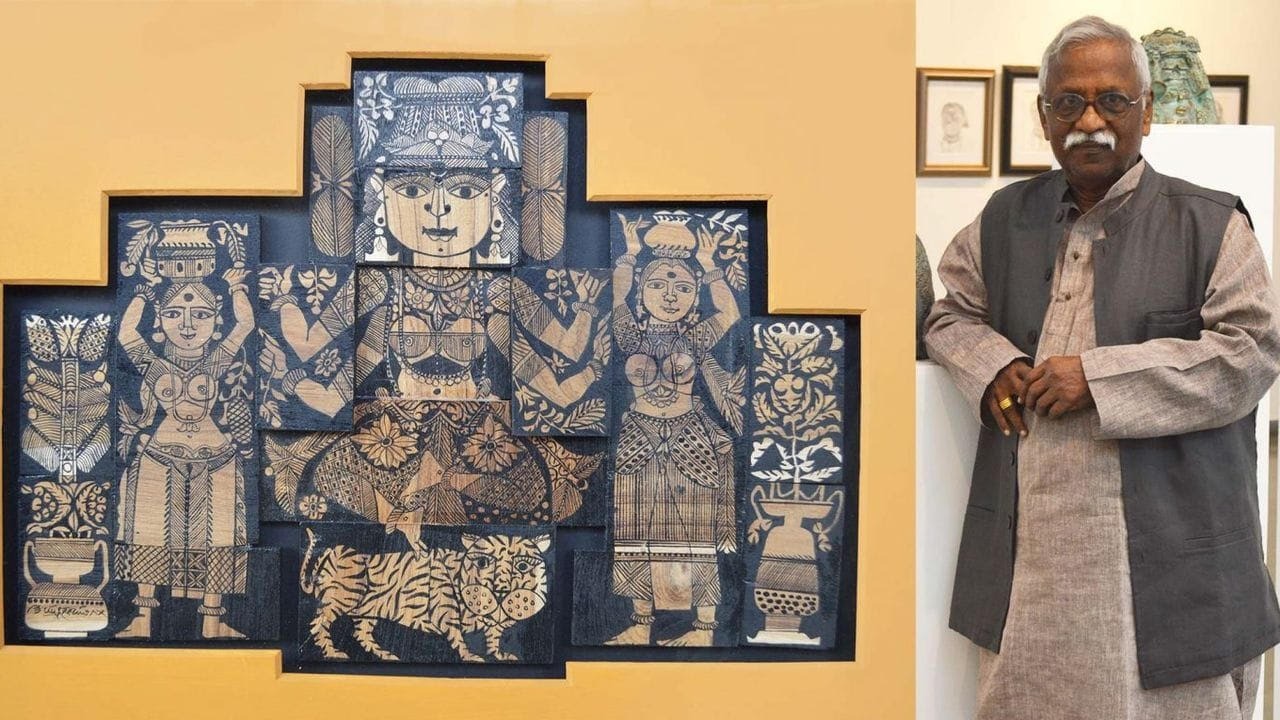
Laxma Goud stands among India’s best known living artists. The painter records village life with exact detail. The mud walls, the goat hides, the sweat on a farmer’s neck all appear on his paper. A woman churns butter – a boy sharpens a sickle – a couple locks eyes beneath a tamarind tree. Each picture holds the plain surface of the day and the silent strain behind it. The viewer sees both the old routine and the new way of seeing it. The work keeps the customs of the fields while it fits them into the language of modern art.
The Artistic Journey of Laxma Goud
Laxma Goud keeps the plain facts of village work, debt, festival in plain sight – the record does not vanish as roads but also cable television move in. Each picture holds the argument that a glance, a turned wrist or a smothered laugh already carries its own full sentence. Goud’s body of work still pulls new painters, teachers and collectors toward it and it secures his place among the figures who shaped late-twentieth-century Indian art.
Laxma Goud was born in Telangana and spent his childhood in a village. He watched the fields, heard the cattle bells and learned the daily sequence of sowing harvesting plus resting. The same routines stayed in his mind and later filled his paintings – he etched copper plates, brushed watercolour on paper and spread acrylic across canvas. Each surface received thick black lines, browns the colour of ploughed earth but also shapes that bend like tired backs.
The pictures show a woman carry water on her hip, a man coax a bullock, children chase each other around a drum circle. A festival appears as a row of oil lamps on a threshold – a quarrel shows itself in two men who stand nose to nose without touching. No speech bubbles are needed – the tilt of a head or the grip on a sickle tells the story. Viewers in Delhi, Paris or New York recognise the gestures because they repeat in every place where people live close to the soil.
Depicting Rural Life with Honesty
The paintings of Laxma Goud show village life exactly as it is. He does not soften the dirt, the tired backs or the cracked hands – he also records laughter beside the water tank and children chasing a tyre. The same canvas holds a woman who pounds chilli at dawn and a farmer who straightens for a moment to ease his spine.
A bull stands in the corner of many pictures, head lowered, rope through its nose – the same animal reappears beside a group of women who carry stacked pots to the well. The repetition fixes the bull as property, as labour plus as the centre of every threshing floor. The women share the same space – the viewer links their lives to its strength and to each other. When Goud paints a night circle of men who pass a clay jar, the huddle of bodies repeats the shape of the cattle shed behind them – the line between owner and animal, between work but also rest, almost vanishes – these echoes of form let the picture speak about debt, kinship and the way one day’s ploughing stretches into the next without comment.
Exploring Human Emotions and Vulnerability
Laxma Goud paints more than village scenery – he studies how people feel. The men, women and animals in his pictures look tired, amused, thoughtful or hungry. He places a burnt umber next to a dull brick red or a deep black against pale skin – the color itself signals comfort or strain.
The women stand at the center of many canvases – he stretches their arms and necks, shows the fold of a sari, the tilt of a head or the tight line of a closed mouth plus in this way he records both the weight they carry and the calm they keep. A viewer from any district or country recognizes the set of the shoulders and reads the same quiet endurance.
Techniques and Style
Laxma Goud mastered etching. The plate holds hair thin lines beside fat black strokes – the contrast carves fur, skin and shadow into the paper. The same sheet shows a tree’s bark and the tightness in a farmer’s jaw – both sit at the same depth because the needle placed them there.
He also picks up watercolour plus acrylic. A red wash runs across a mud wall and stops exactly at the edge of a woman’s sari – the colour stays bright but never reaches her face. A single goat stands in the middle of a wide beige field – behind it, a fence, a well and a row of huts stack in four flat strips. The picture stays simple at first glance – reveals each small thing that lives in a village day.
Celebrating Culture and Tradition
The paintings of Goud give clear space to Indian festivals, folk dances and village rituals. The colours and lines record the sequence of each rite – the drum beat, the circle of dancers, the painted mask, the oil lamp set on the threshold. Each scene fixes a moment that older villagers recall plus younger viewers have only heard named. The canvas holds the gesture of sowing, the pattern of a sari border, the shape of a plough – the eye can return to it after the field has changed. The work stores the memory of the harvest feast and the night long dance beside the banyan and it hands the picture on to people who no longer live beside that tree.
Global Recognition and Impact
Laxma Goud’s work has received national and international acclaim. Major galleries plus museums have exhibited his prints and paintings – viewers outside India have seen the life of rural Telangana through his eyes. Curators but also art schools buy, display and study the pieces because the line work is sure, the stories belong to village life as well as the mood is direct.
ArtAliveGallery keeps a group of his canvases in its viewing rooms. Visitors walk up to them, look at the goats, the women, the night fields and they leave with the option to purchase. Young artists who want old tales in new formats still open his catalogues, copy the cross-hatching besides try to set next to it the world they live in now.
The Timeless Relevance of His Art
Laxma Goud’s paintings stay relevant because they show common truths through clear village scenes. The work shows people at work, in groups, at festivals and in hard times plus any viewer relates to those moments. As cities expand, the pictures keep the habits and knowledge of the village in view.
The artist keeps the human figure at the center – the pictures serve a social purpose beyond looks. He paints daily labor, women but also men in fields or homes and shared tasks as well as he treats each figure with plain respect. The viewer faces questions about gender roles, work rights and group ties. The canvases set village life beside city life, earlier ways beside current ways besides single stories beside shared ones.
Conclusion
Laxma Goud’s paintings do not stop at pictures – they record life, people and the marks of a place. He mixes careful brushwork, sharp detail and steady regard for whoever sits in front of him plus the result fixes the look and feel of Indian villages with a clarity other painters rarely reach. The canvases let a viewer watch a lane at dusk, a woman at a well or a boy with a goat – notice that the same worry or pleasure shown in the village appears in every town.